
There is something almost hypnotic about the glow of a screen in the hands of a toddler.
The instant stillness. The sudden silence. The tiny pause it offers in the middle of an exhausting day.
For many parents, that small rectangle of light can feel like relief.
A chance to answer emails. To cook dinner without someone clinging to your leg. To drink coffee while it is still warm. To simply sit still for a moment after another fractured night of sleep.
And sometimes, at 5am when the house is dark and everyone is overtired, handing over a phone or tablet can feel less like a parenting choice and more like survival.
Modern parenting asks an impossible amount of families. Most parents are carrying far more than anyone sees — work, mental load, financial pressure, overstimulation, interrupted sleep and the constant emotional labour of caring for small children.
So this is not a conversation rooted in guilt.
It is simply an invitation to pause and consider what growing research is quietly revealing about screen time during the earliest years of childhood.
Because while screens may calm a toddler externally, a child’s developing nervous system is often experiencing something very different beneath the surface.
Toddlers Learn Through Human Connection — Not Screens
The early years of life are extraordinarily important for brain development. Toddlers learn through movement, touch, eye contact, conversation, play, rhythm, boredom and connection.
They learn language by hearing voices respond to them.
They learn emotional regulation through co-regulation with safe adults.
They learn about the world through sensory experiences — muddy feet, blocks tumbling onto the floor, pages turning in a bedtime story, songs sung slightly off-key in the kitchen.
Screens, even educational ones, cannot fully replicate these experiences.
Research continues to link excessive screen exposure in young children to difficulties with attention, language development, emotional regulation and sleep quality. Many studies also show that the more time spent on screens, the less time children spend engaged in imaginative play, movement and meaningful interaction with caregivers.
The Particular Problem With Screens Before Bed
One of the clearest concerns researchers continue to highlight is the impact of screens on sleep.
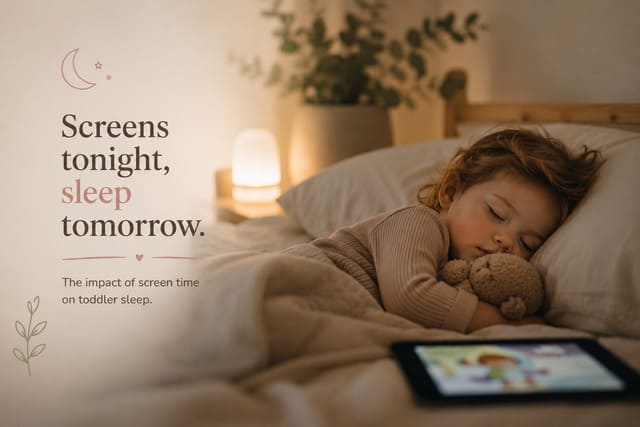
Many parents notice the pattern themselves. A toddler watches a tablet before bed and suddenly bedtime becomes harder. Their body seems tired, yet their nervous system remains alert. They wake more often. Rise earlier. Become more emotionally fragile the following day.
This is not imagined.
The blue light emitted from phones, tablets and televisions suppresses melatonin — the hormone responsible for helping the body prepare for rest. Studies show that screen exposure before bedtime can delay sleep onset, reduce sleep quality and disrupt the body’s natural circadian rhythms.
And toddlers, with their still-developing nervous systems, are especially sensitive to this disruption.
There is also something deeper happening beyond the biology.
Bedtime is not simply a transition into sleep. For young children, it is a gradual softening into safety. A slowing of the body. A quieting of stimulation. A return to connection.
Screens do the opposite.
They flood the senses precisely when the brain is trying to settle.
This is why many experts recommend keeping the hour before bedtime as calm and screen-free as possible, replacing devices with stories, soft music, dim lighting, cuddles or quiet play.
Early Morning Screen Time Matters Too
Early morning screen use is spoken about far less, yet it may be equally disruptive.
When toddlers wake before sunrise — as many do — handing over a device can feel like the only way exhausted parents can get another half hour of rest. And sometimes, realistically, families simply do what they need to do.
But regular early morning screen exposure can unintentionally reinforce very early waking patterns and overstimulate the brain before the day has even properly begun.
The bright light from screens signals to the body that it is time to be fully awake. Fast-paced visual stimulation first thing in the morning can also leave some toddlers dysregulated before breakfast has even been eaten.
Over time, children may begin relying on screens not only for entertainment, but for emotional regulation itself — reaching for external stimulation whenever boredom, discomfort or fatigue arise.
Yet boredom, slowness and gentle transitions are deeply important for childhood development.
There is something profoundly regulating about slow mornings.
A cuddle under a blanket.
A story read half-awake.
Small hands helping stir pancake batter.
Birdsong through an open window.
These ordinary moments shape childhood far more than we realise.
This Is About Balance — Not Perfection
No parent manages screen time perfectly.
Some days are long. Some children are sick. Some parents are depleted beyond words. Sometimes survival mode takes over, and that does not make anyone a bad parent.
Children do not need perfection.
What they need most are loving, responsive caregivers who repair, reconnect and keep trying again.
The good news is that small changes truly matter.
A slightly earlier bedtime routine.
A basket of books beside the bed instead of a tablet.
A slower morning rhythm.
Ten more minutes of connection before turning on the television.
These moments may seem small, but for a young child’s nervous system, they are significant.
Because childhood is built quietly.
Not through grand gestures, but through repeated rhythms of safety, connection and presence woven gently through ordinary days.